Lockerbie Then & Now


It was shortly after 7:00 p.m. on December 21, 1988, just a few days before Christmas when Pan Am 103 exploded in the skies above Lockerbie. A bomb, controlled by a timer, had detonated. The plane wreckage and passengers rained down upon the town, its buildings, and the surrounding landscape. The maelstrom of burning jet fuel, jagged metal, and destruction stretched across 845 square miles.
The plane’s nose cone, containing the cockpit and first-class cabin, crashed in a field across the road from Tundergarth Church, three miles east of Lockerbie, where it became one of the most iconic images of the aftermath. The rear section of the fuselage crashed in the Rosebank area of town. The central fuselage and fuel-laden wings tore through Sherwood Crescent neighborhood, resulting in an explosion that hurled 1,500 tons of debris into the air and left a 155-foot-long crater. The explosion blew the roofs off of nearby homes and shattered doors and windows.
The impact was so intense that it registered as a seismic event of magnitude 1.6 on the Richter scale. Fires burned across an area more than a mile long and a half-mile wide. Forty houses were destroyed or had to be demolished. Amid the violent attack’s wreckage were the bodies of 270 murder victims: 11 Lockerbie residents and 259 passengers and crew members. Lockerbie had become a disaster zone.
Sherwood Crescent


The aircraft disintegrated at 31,000 feet leaving a trail of wreckage more than 80 miles long across Scotland and England. Sherwood Crescent neighborhood, in the heart of Lockerbie and adjacent to the motorway, was severely damaged when the jet's wings crashed into the area. The impact created a crater and resulted in a major fire when the fuel inside the wings ignited. An underground gas main was ruptured; and the primary water main was severed by one of the engines that crashed into Mains Meadow.


When the aircraft's wing section crashed near the A74 motorway, at the southern edge of Lockerbie, it hit the ground with enough force to measure 1.6 on the Richter scale and gouged a 155-foot-long crater out of the ground. The fireball that was created set fire to neighboring houses.


The impact of the jet's wings, which had broken away from the rest of the fuselage at around 9,000 feet, displaced more than 1,500 tons of debris when they crashed straight down into Lockerbie. Debris was blown downwind for several miles.
Rosebank Crescent


The explosion ripped through the cargo hold. A 60-foot-long section of the fuselage, including the right-wing landing gear and several pallets and luggage containers, crashed at a housing estate in Rosebank Crescent neighborhood, some 600 meters from the crater at Sherwood Crescent.


The section of the fuselage that crashed in Rosebank Crescent neighborhood destroyed one house and damaged several others.


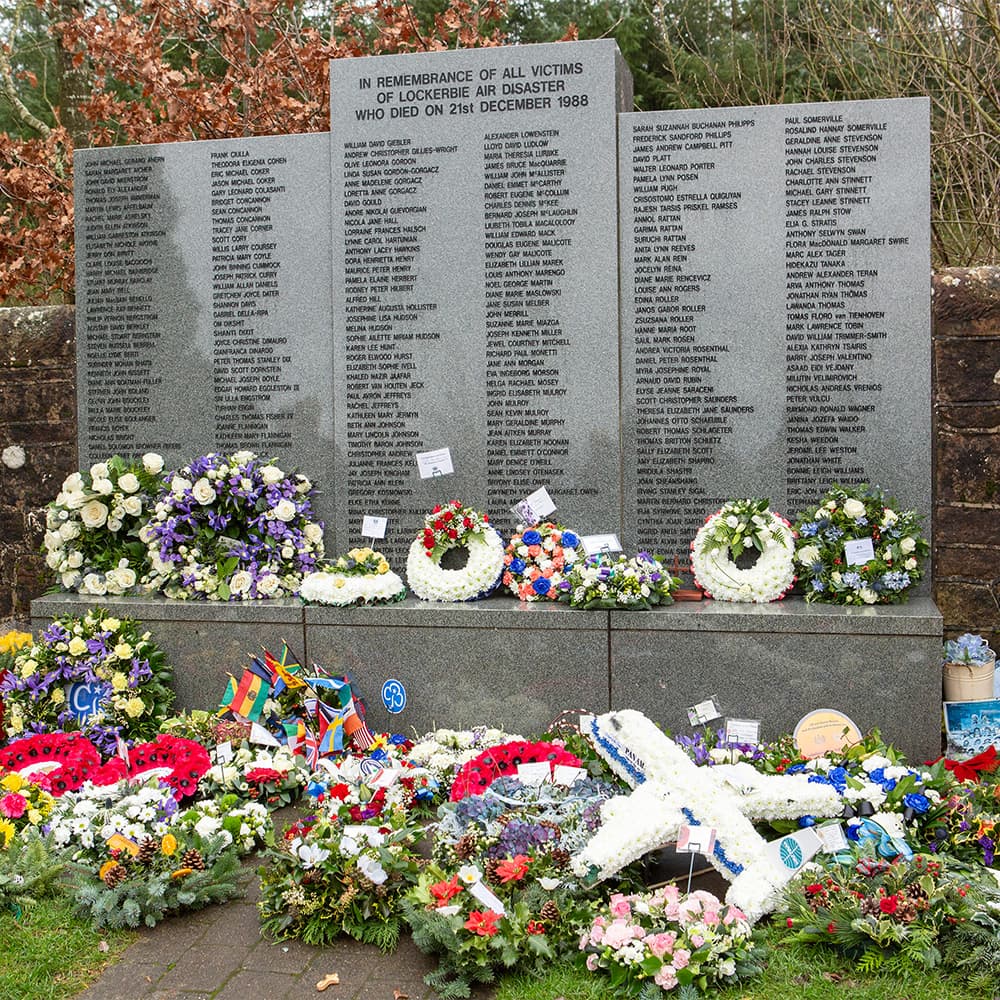
On Rosebank Crescent, a small memorial now stands.
Tundergarth


The nosecone, consisting of the cockpit and first-class seating of the plane crashed some three miles east of Lockerbie across from Tundergarth Church. Despite the damage, flight crash investigators were able to inspect the jet's controls which showed the aircraft had been in "normal operation in cruising flight." The flight crew had no advance notice of the catastrophic explosion and were unable to make a Mayday emergency call.
Alexandra Drive


Engine number 3 crashed at Alexandra Drive and became deeply embedded in the roadway. Residents of Lockerbie reported hearing noise like the roar of a jet engine that appeared to be coming from a "meteor-like" object with a trailing flame and that the noise grew progressively louder until it was deafening.


This heavy piece of wreckage from one of the aircraft's four engines narrowly missed nearby homes. The other three engines crashed in the Mains Meadow part of town.


Alexandra Drive has since been restored.
High Street


Prince Charles visited Lockerbie in the aftermath of the tragedy. Here he bows his head in a mark of respect outside the Town Hall days after the attack. Town Hall served as the first mortuary and casualty bureau. A colorful stained-glass window, featuring the flags of the 21 nations the victims represented, was installed as a permanent memorial dedicated to the 270 victims of the terrorist bombing.
Your story is our history
Share your unique story of how the December 21, 1988, terrorist attack affected your life. Preserve your memories and legacy while helping to create the most extensive digital library of personal stories about the Pan Am 103 attack.